Stem Cells and Hair Growth: 9 Proven Benefits and What to Expect in 2027
Stem Cells and Hair Growth: Benefits, Science, and What to Expect
Hair loss is one of the most common and emotionally impactful conditions in medicine — affecting approximately 50% of men and 25% of women by age 50, with significant effects on self-image, confidence, and quality of life. For decades, treatment options were limited to medications that require continuous use to maintain their effects, or surgical procedures that redistribute existing hair without addressing underlying biology.
Stem cell therapy represents a fundamentally different approach: rather than masking or redistributing hair loss, it targets the biological mechanisms driving it — attempting to restore the scalp environment and follicular activity that supports natural, healthy hair growth.
Why Hair Loss Is So Common
Understanding why hair loss is so prevalent requires understanding the biology of the hair follicle and what disrupts it:
- Androgenetic alopecia (pattern hair loss): The most common form — affecting 80% of men by age 70 and 50% of women. Driven by dihydrotestosterone (DHT) binding to follicle androgen receptors, causing progressive miniaturization of hair follicles over years to decades
- Telogen effluvium: Diffuse shedding triggered by physiological stress — illness, surgery, dramatic weight loss, hormonal shifts (postpartum, menopause), nutritional deficiencies — causing an abnormally high proportion of follicles to enter the resting (telogen) phase simultaneously
- Alopecia areata: Autoimmune attack on hair follicles — patchy hair loss that can progress to complete scalp (alopecia totalis) or body (alopecia universalis) hair loss
- Scarring alopecias: Inflammatory conditions that destroy follicles permanently — lichen planopilaris, frontal fibrosing alopecia, discoid lupus
- Age-related decline: Beyond androgenetic alopecia, the aging scalp develops reduced microvascular density, diminished follicle stem cell populations, and chronic low-grade inflammation that collectively impair follicular function
The Rise of Regenerative Hair Treatments
The limitations of conventional hair loss management have driven growing interest in regenerative approaches:
- Finasteride and minoxidil — the two FDA-approved first-line treatments — require continuous use to maintain effects. Stopping either results in resumed hair loss. Neither restores follicles; they slow the process
- Hair transplant surgery — distributes existing hair more favorably but does not create new follicles or address the continuing process that will affect the transplanted area's neighbors
- PRP (platelet-rich plasma) — an established regenerative adjunct that stimulates follicle activity through growth factor delivery, but requires regular sessions and has moderate effect size in most patients
Stem cell therapy aims for something more fundamental: changing the biological environment of the scalp in ways that durably improve follicle health, activity, and survival.
What Are Stem Cells and How Do They Relate to Hair?
The Hair Follicle's Own Stem Cell System
Hair follicles are one of the few structures in the body that undergo cyclical regeneration throughout life — cycling through growth (anagen), regression (catagen), and rest (telogen) phases repeatedly. This regenerative capacity depends on a resident population of follicle stem cells located in the "bulge" region of the outer root sheath.
These follicle stem cells activate at the onset of each anagen phase, proliferating and differentiating to regenerate the lower follicle structure needed for hair growth. They also serve as the reservoir for replacing damaged follicle cells throughout the cycle.
Hair loss conditions impair this follicle stem cell system through several mechanisms:
- DHT (in androgenetic alopecia) progressively shortens anagen and eventually miniaturizes the follicle
- Inflammatory cytokines damage the follicle stem cell niche, impairing activation
- Vascular insufficiency reduces the oxygen and nutrient supply the follicle stem cells depend on
- Fibrosis (in scarring alopecias) irreversibly destroys the follicle stem cell compartment
How Exogenous MSC Therapy Supports Follicle Biology
Mesenchymal stem cells (MSCs) administered to the scalp act primarily through paracrine signaling — releasing growth factors, cytokines, and exosomes that modify the biological environment in which follicle stem cells operate:
- Wnt/β-catenin pathway activation: One of the primary signals driving follicle stem cell activation and anagen initiation. MSC-derived Wnt ligands and inhibitors of the Wnt pathway's negative regulators promote follicle stem cell transition from rest to growth phase
- VEGF secretion: Improves scalp microvascularization, increasing the oxygen and nutrient delivery to follicle stem cells — addressing the vascular insufficiency component of hair loss, particularly in androgenetic alopecia
- KGF (Keratinocyte Growth Factor) and HGF (Hepatocyte Growth Factor): Directly stimulate follicle keratinocyte proliferation and differentiation — the cellular basis of hair shaft production
- IGF-1: Prolongs anagen duration, the growth phase, extending the period during which each follicle produces hair before entering rest
- Anti-inflammatory cytokines (IL-10, TGF-β): Reduce the perifollicular inflammation that miniaturizes follicles in androgenetic alopecia and damages follicle stem cell niches in inflammatory alopecias
How Stem Cells Help with Hair Growth: 3 Core Mechanisms
1. Activating Dormant Hair Follicles
Many follicles in pattern hair loss are not permanently lost — they are miniaturized and in a prolonged telogen state. The follicle stem cell population is often still present but inadequately signaled to reactivate.
MSC therapy's paracrine signals — particularly Wnt pathway activation and growth factor delivery — can reactivate dormant follicles, triggering a new anagen phase and producing visible new hair growth in areas that appeared thinning or sparse.
This is the most clinically significant mechanism for androgenetic alopecia: the mini-follicles that have survived but shrunk can often be partially restored rather than requiring new follicle creation (which current technology cannot achieve).
2. Improving Scalp Blood Flow and Vascularization
The hair follicle is one of the most metabolically active structures in the body during anagen — requiring extensive oxygen and nutrient delivery. Each follicle is served by a dedicated capillary loop that forms during anagen and regresses during telogen.
In androgenetic alopecia, scalp microvascular density is significantly reduced compared to non-balding scalp. This vascular insufficiency contributes to follicle miniaturization by limiting the metabolic support for anagen.
MSC-derived VEGF and angiogenic factors stimulate new capillary formation in the scalp — improving follicle perfusion and creating a vascular environment more conducive to sustained anagen. This angiogenic effect is one of the mechanisms through which both MSC therapy and PRP improve hair outcomes, and it is particularly relevant in areas of advanced thinning where vascular density has declined most.
3. Regenerating the Scalp Microenvironment
The follicle stem cell niche — the specialized tissue environment in the bulge region — is critical to follicle stem cell survival and activation. Chronic inflammation, oxidative stress, and fibrosis degrade this niche, progressively impairing follicle stem cell function even before the follicle is visibly affected.
MSC therapy's anti-inflammatory, antioxidant, and anti-fibrotic effects restore a healthier niche environment — reducing the ongoing damage that drives progressive hair loss and creating conditions in which both the remaining follicle stem cells and any reactivated follicles can function more effectively.
9 Benefits of Stem Cell Therapy for Hair Growth
1. Thicker, Fuller Hair Shaft Diameter
One of the first measurable improvements in MSC hair therapy: increased hair shaft diameter (caliber). Miniaturized follicles in androgenetic alopecia produce progressively thinner hair shafts — a process partially reversible with adequate biological stimulation. MSC therapy's growth factor delivery to dermal papilla cells (the follicle's signaling center) stimulates the production of thicker hair shafts over successive growth cycles.
2. Reduced Hair Shedding
The anti-inflammatory and anti-androgenic microenvironmental effects of MSC therapy slow the miniaturization process — reducing the rate at which follicles progress from terminal (full-size) to miniaturized (thin) to vellus (imperceptibly fine) to absent. For many patients, slowing or stopping this progression is the most clinically meaningful outcome.
3. New Hair Growth in Thinning Areas
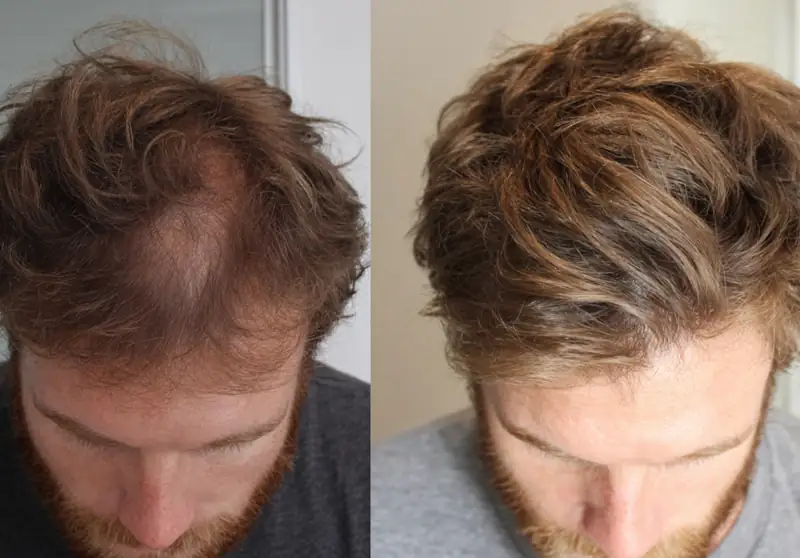
In areas where follicles are miniaturized but not permanently lost, MSC therapy can reactivate dormant anagen — producing visible new hair growth in areas that appeared uniformly thinning. This new growth typically appears at 2–4 months post-treatment as reactivated follicles complete their first new anagen cycle.
4. Healthier Scalp Condition
MSC therapy's anti-inflammatory effects benefit the scalp broadly — reducing seborrheic inflammation, improving barrier function, and creating a healthier tissue environment. Patients frequently report improved scalp comfort, reduced itching, and better overall scalp condition independent of hair growth outcomes.
5. Extended Anagen (Growth Phase) Duration
IGF-1 and KGF from MSCs extend the anagen phase of each hair cycle — meaning hair grows for longer before entering the resting phase. This alone increases total hair density, as more follicles are in active growth at any given time.
6. Improved Hair Transplant Outcomes
MSC therapy is increasingly used as an adjunct to hair transplant surgery — administered at the time of transplantation to improve graft survival, accelerate anagen onset in transplanted follicles, and protect the native follicles surrounding the recipient sites from the surgical stress. Published data show improved graft survival rates with MSC co-administration versus transplant alone.
7. Durable Results Without Continuous Pharmaceutical Use
Unlike finasteride and minoxidil — which must be taken continuously to maintain their effects and produce immediate loss of benefit upon discontinuation — stem cell therapy aims for durable biological change. The angiogenic, anti-inflammatory, and follicle-activating effects persist for months to years, with maintenance sessions designed to sustain rather than restart the biological improvement.
8. Minimal Downtime
The procedure itself is minimally invasive — scalp injections performed under topical anesthesia — with no surgical recovery period. Mild swelling and redness resolve within 24–48 hours. Most patients return to normal activity the same day.
9. Natural-Appearing Results
Because MSC therapy works with existing follicles rather than redistributing or replacing them, the results are inherently natural — improvements in the patient's own hair, distributed according to their natural growth pattern, without the telltale signs of transplant surgery.
Stem Cells vs Other Hair Loss Treatments
PRP vs Stem Cell Therapy
Every plan is personalized. Message us on WhatsApp and we'll send your quote after reviewing your case.
Clinical recommendation: PRP is often used as a first-line regenerative treatment and as maintenance between MSC sessions. For moderate-to-advanced androgenetic alopecia or non-responding PRP cases, MSC therapy offers a more potent regenerative stimulus. The combination — PRP + exosomes + MSCs — is used in advanced protocols for maximum effect.
Medications vs Regenerative Therapy
Finasteride (Propecia):
- Mechanism: 5-alpha reductase inhibitor — reduces DHT levels systemically
- Effect: Slows miniaturization in 90% of users; modest regrowth in ~65%
- Duration: Must be taken continuously; hair loss resumes within 12 months of stopping
- Limitations: Systemic side effects in some men (libido, sexual function); does not restore vascular density or follicle niche health
Minoxidil (Rogaine):
- Mechanism: Potassium channel opener — increases scalp blood flow and extends anagen duration
- Effect: Slows loss and modest regrowth; most evident on crown and vertex
- Duration: Continuous use required
- Limitations: Topical formulation has compliance limitations; does not address follicle stem cell biology or inflammation
Stem cell therapy: Addresses multiple components of hair loss pathology simultaneously — DHT-independent inflammation, vascular insufficiency, follicle stem cell niche degradation — through mechanisms that persist long after the treatment session rather than requiring continuous administration. Not a replacement for medications in all cases — for many patients, the optimal approach combines pharmaceutical protection (finasteride if appropriate) with regenerative stimulation (MSC/PRP) for complementary mechanism coverage.
What to Expect from Stem Cell Hair Treatment in Medellín
Pre-Treatment Assessment
A proper hair restoration consultation includes:
- Scalp examination under trichoscopy — assessing follicle density, miniaturization pattern, and scalp condition
- Trichogram or phototrichogram for quantitative hair density measurement at baseline
- Hormonal assessment where relevant (testosterone, DHT, thyroid panel)
- Medical history review — identifying contributing factors and contraindications
- Photographic documentation for objective outcome comparison
The Procedure
- Topical anesthetic cream applied to the scalp 45–60 minutes before treatment
- Cell preparation: MSCs processed from adipose tissue or allogeneic cord blood source
- Scalp injection: MSCs administered through multiple small-volume injections across the treatment area using fine needles
- Optional: Exosome application and/or microneedling with PRP immediately following MSC injection for synergistic effect
- Post-procedure care instructions: Mild scalp care protocol for 48–72 hours
Total procedure time: 60–90 minutes. Outpatient — no admission required.
Timeline of Results
- Weeks 2–4: Reduced shedding; early scalp environment improvement
- Months 2–3: Visible new hair emergence in previously thinning areas as reactivated follicles complete their first new anagen cycle; increased hair density
- Months 4–6: Full development of first treatment cycle results — thicker hair shafts, improved overall density, more complete coverage of previously thinning areas
- Months 6–12: Continued improvement as subsequent hair cycles benefit from improved follicle biology; maintenance session planning
Safety and Who Should Consider It
Side Effect Profile
Scalp MSC injection has an excellent safety profile:
- Mild swelling and redness at injection sites: universal; resolving within 24–48 hours
- Temporary scalp tenderness: common; resolving within a few days
- Minor bruising at injection points: occasional; resolving within a week
- Infection: very rare with proper sterile technique
No serious adverse events have been reported in published clinical trials of scalp MSC administration.
Best Candidates
- Early to moderate androgenetic alopecia: The most responsive population — follicles are miniaturized but not permanently lost; reactivation is achievable
- Non-responding PRP patients: Patients who have used PRP without adequate response may benefit from the more potent biological stimulus of MSC therapy
- Pre- and post-hair transplant patients: MSC therapy improves graft survival and protects native follicles when used perioperatively
- Diffuse telogen effluvium not recovering: MSC therapy can accelerate recovery of follicle stem cell activity in prolonged effluvium
- Alopecia areata (selected cases): MSC therapy's immunomodulatory effects are under investigation for autoimmune hair loss
Who may not be ideal candidates: Active scalp infection, active malignancy, certain autoimmune conditions on systemic immunosuppression — to be determined in individual consultation.
Stem Cell Hair Treatments in Medellín: Why It's a Top Destination
Medellín has become one of the preferred international destinations for hair restoration using regenerative medicine:
- Cost: Stem cell hair therapy in Medellín is priced at 60–75% below equivalent quality treatment in the US. This makes multi-session protocols — which produce the best outcomes — financially accessible
- Integrated protocols: At YouMedicine, hair restoration is approached within the broader context of regenerative medicine — MSC scalp injection combined with exosomes, PRP, and systemic treatments that improve the overall biological environment contributing to hair health
- Experienced physicians: Specialists in both aesthetic medicine and regenerative biology — with the expertise to design protocols appropriate for each patient's specific pattern and etiology of hair loss
- Medical tourism infrastructure: Programs designed for international visitors, with accommodation coordination, telemedicine follow-up, and remote maintenance protocol management
FAQs About Stem Cells and Hair Growth
Do stem cells actually regrow hair?
Yes — with important qualification. In patients with miniaturized but not permanently destroyed follicles (the majority of androgenetic alopecia patients), MSC therapy can reactivate dormant follicles and produce new visible hair growth. Results vary by individual biology, degree of loss, and treatment protocol. Published pilot studies show meaningful improvement in hair count and density in responding patients.
How long do results last?
Significantly longer than pharmaceutical treatments. Most patients maintain improvements for 12–24 months after an initial series of sessions. Maintenance treatments every 12–18 months sustain the biological foundation established in the initial program.
Is the treatment painful?
Minimal discomfort. Topical anesthesia applied before the procedure makes the scalp injections well-tolerated by most patients — comparable in discomfort to PRP scalp injection, which most hair restoration patients report as very manageable.
Is it better than PRP?
For moderate-to-advanced cases or PRP non-responders, yes — MSC therapy provides a more comprehensive regenerative stimulus through Wnt signaling, stronger angiogenesis, and anti-fibrotic effects that PRP alone does not deliver. The combination of MSCs + exosomes + PRP is stronger than any single modality.
How many sessions are needed?
Typically 1–3 initial sessions spaced 1–2 months apart, followed by annual or biannual maintenance. Protocol design depends on severity of loss, treatment response, and individual biology.
Where can I learn more about the clinical evidence?
The Journal of the American Academy of Dermatology and International Journal of Trichology publish peer-reviewed research on regenerative hair restoration.
Conclusion
Stem cell therapy for hair growth represents one of the most biologically sophisticated approaches to hair loss currently available — targeting the vascular, inflammatory, and follicle stem cell biology driving loss rather than managing symptoms indefinitely.
The science is genuine. The mechanisms are well-characterized. The early clinical evidence is encouraging. And the treatment is safe in qualified clinical settings.
For individuals with early to moderate hair loss seeking a more durable, biologically grounded alternative to lifelong pharmaceutical management, stem cell therapy in Medellín offers a compelling option — with experienced physicians, advanced protocols combining MSCs with exosomes and PRP, and costs that make comprehensive treatment accessible.
At YouMedicine, we design individualized hair restoration programs within the context of comprehensive regenerative medicine — understanding that scalp health is connected to systemic inflammation, vascular health, and hormonal balance, and treating accordingly.
Contact us at wellness@youmedicine.co or via WhatsApp at +57 324 576 1913 to schedule your hair restoration consultation.
Your wellness starts with YOU.